

Psychological Safety Is Not Built for VPs
The distance between what senior leadership feels like and what it has to look like — and why "be more vulnerable, be more authentic" misses what these leaders actually face.

If my writing has value to you, your ‘like’ has value to me. Click the heart! It helps by raising this article’s profile on Substack. Thank you for the gift.

I have sat across from hundreds of senior leaders in the most unguarded conversations of their professional lives. What I find in those sessions is not what their organizations see.
Their organizations see a capable executive who has it handled. Someone who projects stability, gives sharp answers in the all-hands, and holds steady under pressure.
What I see is the person who was awake at 2 a.m. before that all-hands. The internal monologue of self-criticism their team would not recognize if they heard it. Someone who has not had a genuine, unguarded conversation with a peer in months, because their peers are also the competition. Someone who is, in some fundamental way, alone with all of it.
This is the gap we should be talking about. Not the one between ambition and achievement. The gap between what leadership at this level actually feels like and what it is required to look like.
The standard advice
The standard advice for this gap is well-rehearsed. Be more vulnerable. Be more authentic. Build psychological safety. Each one names something important, but often misses what the leader is actually facing.
Vulnerability is being prescribed to a leader who has nowhere to put it. Authenticity is being asked of someone in an environment that penalizes it. Psychological safety is something the leader is building for the team; it’s not being built for the executive.
At this level, the gap is almost never a failure of effort. The reason this gap exists is structural. And it’s worth being real about these limitations.
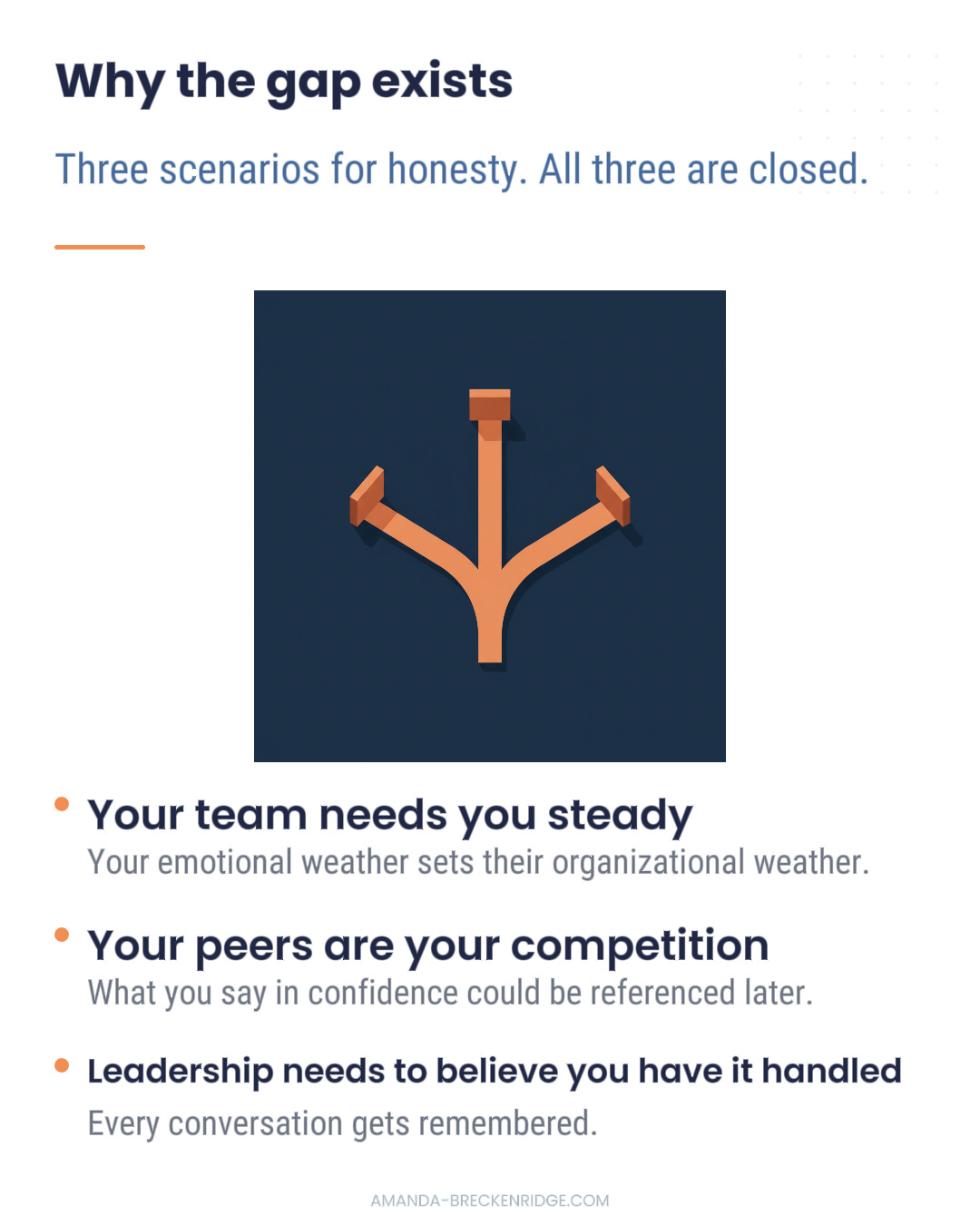
Why the gap exists
There are three scenarios where you might be honest about how the role is impacting you. All three of them, for different reasons, are closed.
Your team needs you to be steady.
Your emotional weather sets their organizational weather. Walk in uncertain and they read instability. Show strain in a 1:1 and the person across from you starts wondering if their job is safe. So you contain it, because containment is part of the job.
Your peers are also your competition.
The honest dinner conversation, the one where you would say this year has been brutal, I don’t know how to do this part yet, is the conversation you don’t have with the people who would understand it best. Your peers are often running for the same scope. They are evaluated against you when budget gets allocated, when promotions are decided, when succession is named. What you say in confidence could be referenced the next time your name comes up.
The person above you needs to believe you have it handled.
The board. The CEO. The chair. The reason you have the role is in part because they trust you to handle the role. Every conversation gets remembered. And the remembered version of you needs to stay coherent with the version they hired or promoted.
The circle of people who could receive the real version is closed off. The gap has nowhere to go so it stays.
Your composure keeps the gap locked
The ability to deliver certainty when the ground is moving, to hold a standard nobody else is operating at, to stay steady when other people would crack — those are the strengths that made you senior. They are also what the role still requires of you every day.
One client described it as “having to have the battle in me in order to present the perfect thing to the world.”
The external appearance is polished. The internal process is war. And because the composure holds, nobody sees the war. Including, sometimes, you.
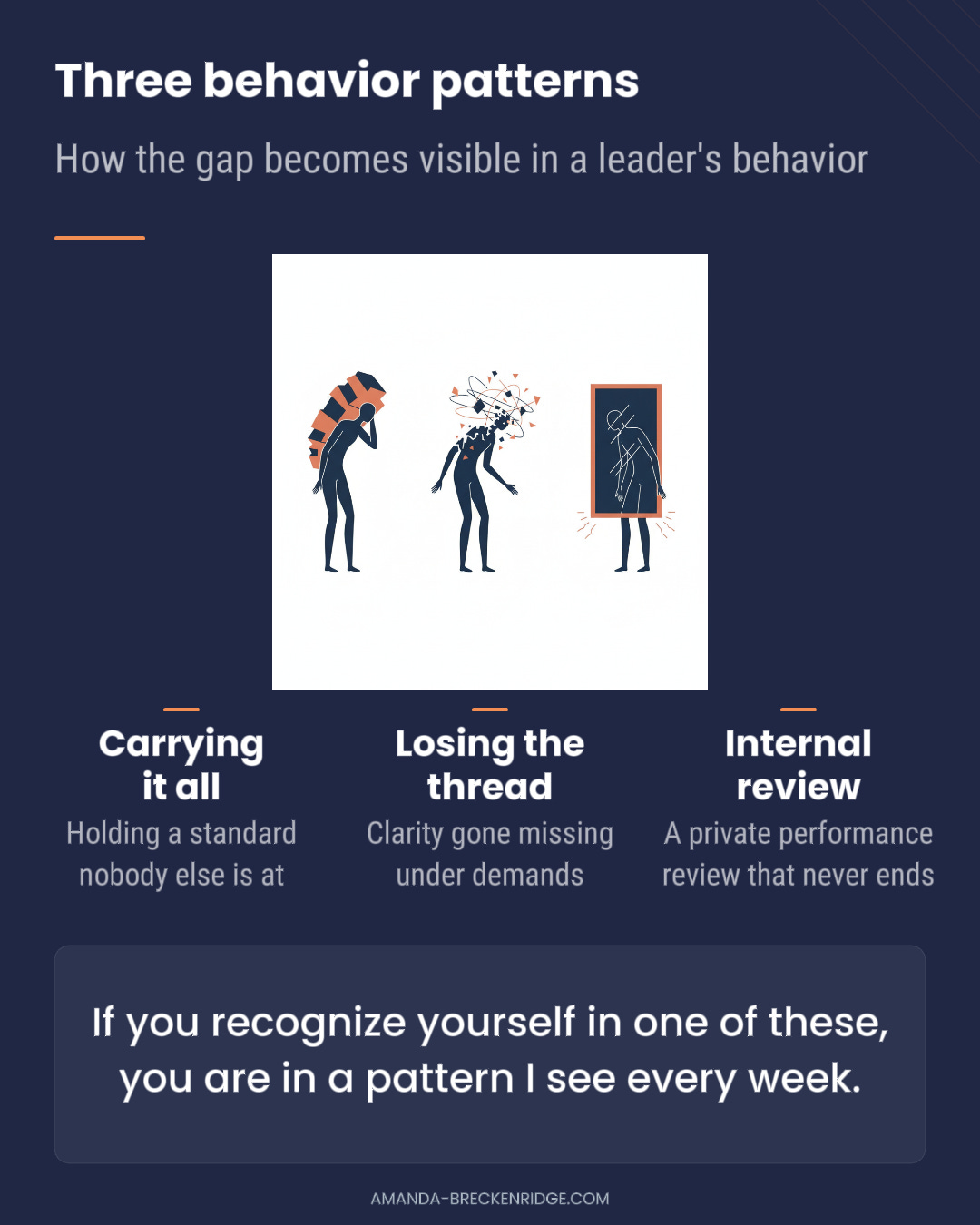
Three behavior patterns
I’ve observed three ways the gap becomes visible in a leader’s behavior.
Carrying it all
On the outside, this leader is performing at the highest level. On the inside, they have not slept properly in months. They are holding themselves to a standard nobody else is operating at, while their team wants to contribute but struggles to find a point of entry.
Losing the thread
This leader appears collaborative, stakeholder-savvy, and smooth across rooms that do not usually agree. On the inside, they’re stretched across so many competing demands that their own clarity has gone missing. They absorb other people’s weight all day and arrive home with nothing left. One told me, “I don’t want to take on anybody else’s problems. I want to go home and be alone. I’ve done this with so many people all day long.”
The internal review that never ends
This leader is polished, capable, and produces high-quality work. On the inside, they run a private performance review of everything they said, every place they fell short, holding themselves to a standard they’d consider unfair if applied to anyone on their team. The internal voice is loud enough they assume it shows. But it doesn’t. The relief at hearing this is a pattern is real. So is the grief of having carried it alone for so long.
If you recognize yourself in one of these, or in some combination, you are in a pattern I see every week.
What it costs the organization
The cost of this is not only personal.
A leader holding the gap alone is making decisions from depletion. Their judgment loses its edge. Risk tolerance narrows. And the energy that would have gone into the harder, longer-horizon question gets spent on the closer, more solvable one. And the pattern is replicated. Every layer of leadership below is watching how composure is performed at the top and learning to operate the same way. By the time it shows up as attrition or burnout at the executive level, it has been compounding for years.
What actually helps
The solution is not bigger than the problem. It is smaller. It’s one safe place.
Instead of advocating for vulnerability everywhere or authenticity for all leaders, I recommend one conversation, with one person, where you can say I don’t know how to do this part yet, or I’m scared of what happens if I slow down, or I feel more alone in this than anyone realizes. Those sentences stay where they are spoken. They carry no consequence. They are heard as truth by someone whose work depends on protecting the conversation.
The reason this is enough is because we are not trying to close the gap. The gap just needs to be witnessed. The reason it fuels the patterns is because it has nowhere to exist except inside your head. The moment it exists in two people’s heads instead, it stops being a private burden and becomes a known one. The pressure starts to release when it stops being solitary.
– Amanda

I work with Founders & C-Suite Executives on three key levels:
Strategic: Strengthen clarity and decisiveness in complex, high-stakes environments.
Leadership: Evolve and scale your leadership capabilities in line with what the business needs.
Inner Work: Address internal patterns that shape how you operate under pressure so you can lead with intention and sustainability.
I offer a complimentary discovery session to assess fit. I’d love to hear from you.