

The VP Trap
You learned to lead through people. You haven’t yet learned to lead them somewhere hard.

This is the third part of a four-part series on how a leader’s greatest strength at one level becomes their ceiling in the next. For the introduction, start here. Then move on to The Senior Director Trap. The final installment will explore the SVP role.

A VP I was working with received feedback from her team that wasn’t what she hoped for.
It was positive feedback. They thought of her as collaborative, approachable, and easy to bring problems to. People wanted to work for her.
But she felt disappointed. The feedback was accurate. What it didn’t say was everything.
Nobody said she gave them direction they could run toward. Nobody said they knew exactly where things were going. Nobody said she was the reason they did their best work.
They liked working with her. Nobody was following her.
The transition to VP
At Senior Director, the main shift is learning to lead through people rather than alongside them. This means stepping back from execution, focusing on developing your team, and translating your expertise to help them grow.
Most VPs make that transition. The data from my study of 40+ senior leaders shows that the tendency to stay close to execution, maintain tight oversight, and step in when things are moving too slowly drops by a third between Senior Director and VP.
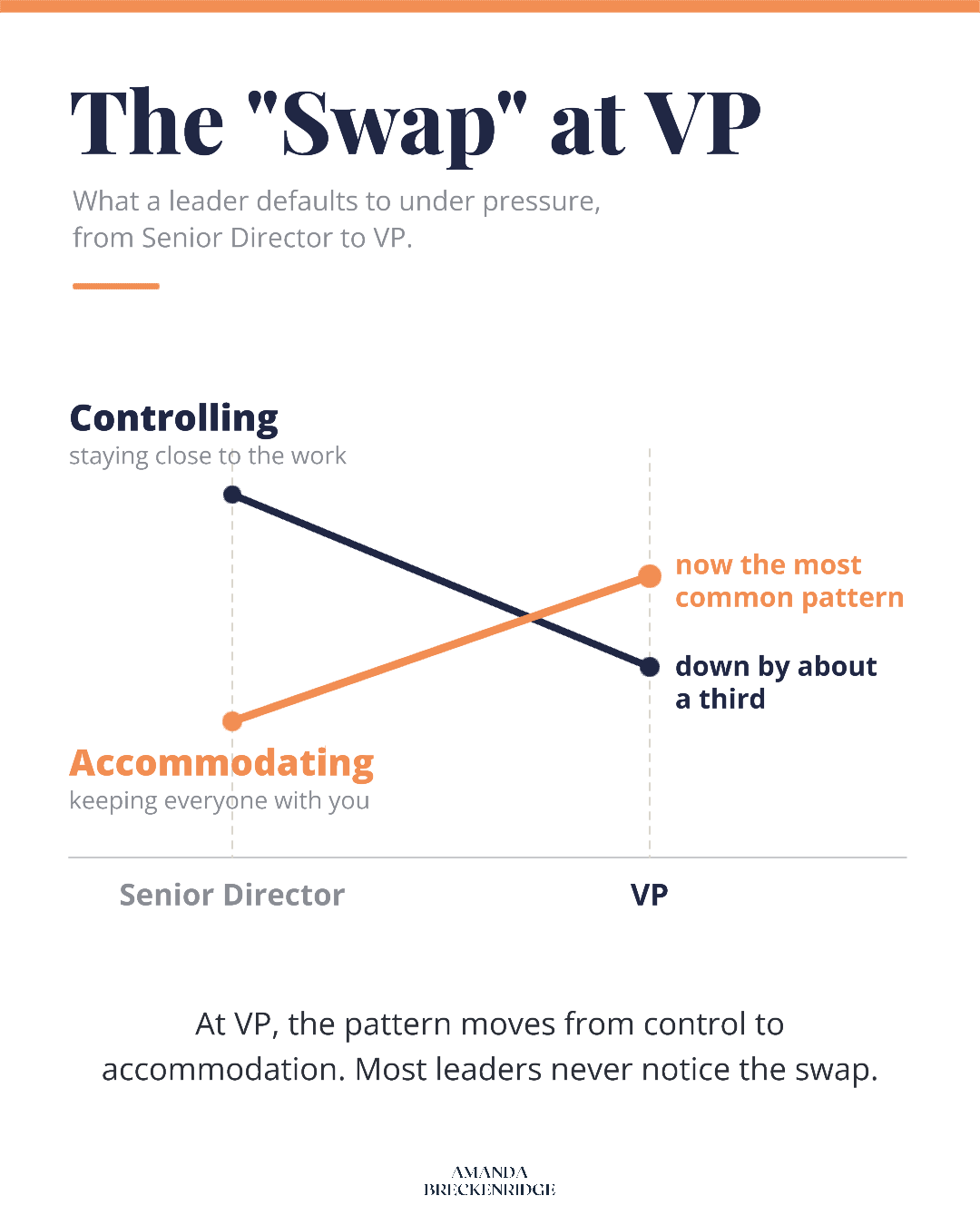
But the data shows something else: most VPs never fully give up their doer identity. Instead, they develop a new layer on top of it. They become the person who keeps everyone aligned and moving. They are collaborative, easy to work with. Meanwhile, the doer identity continues to run underneath.
Which means they arrive at VP carrying two identities, while the role hands them a third.
Three jobs, one person
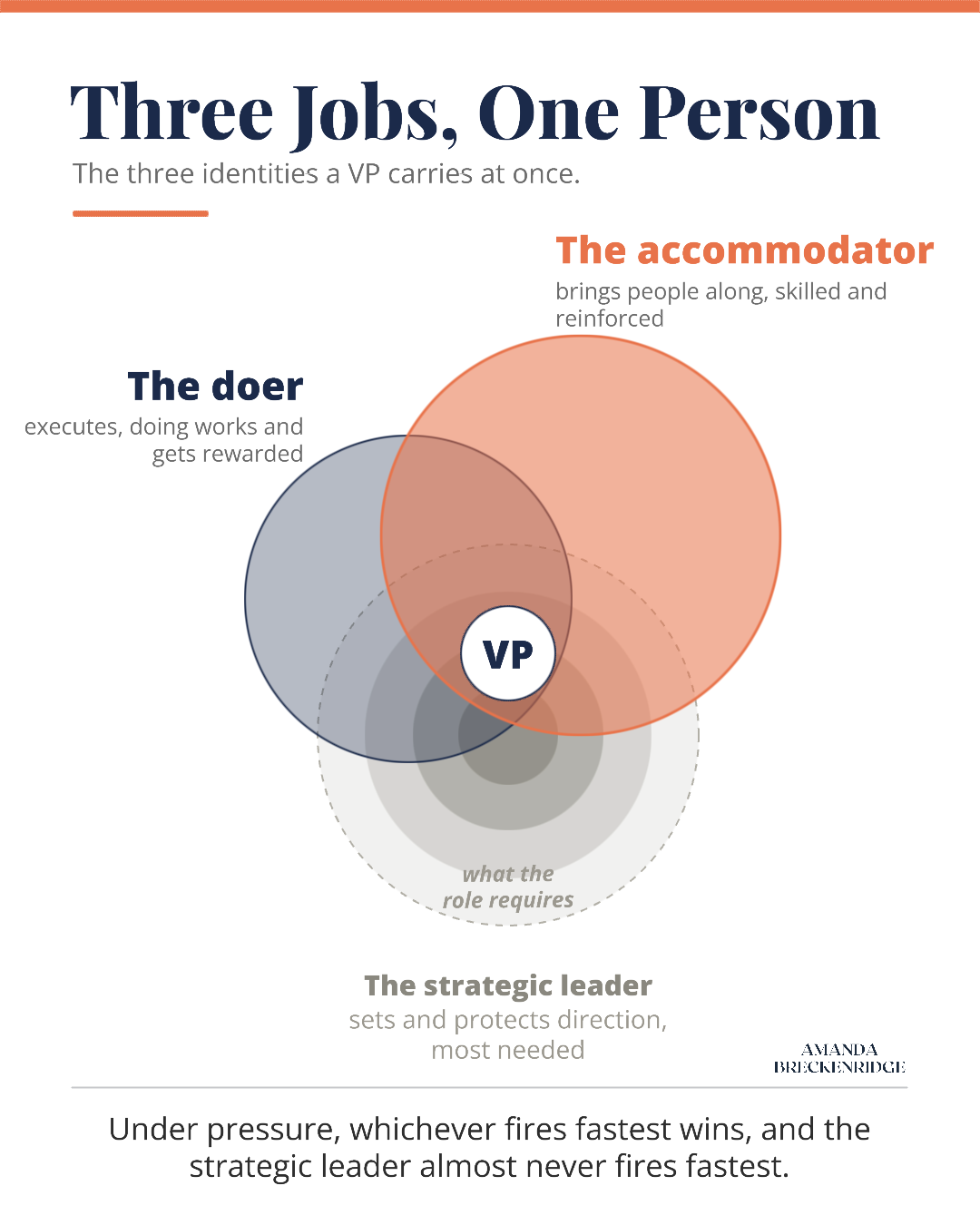
The VP role requires you to be three things at the same time.
The doer: the person who gets things done, has high standards, and can step in and deliver when it matters. That identity fires under pressure. And it gets rewarded because execution still works.
The accommodator: the leader who brings people along, clears the path, removes obstacles, and makes sure the team can move. It’s practiced and sophisticated, and it gets positive reinforcement constantly.
The strategic leader: the one who sets a clear direction, protects it under pressure, and develops others to lead rather than execute. That’s the identity the role most requires, yet is the one with the least development. The other two are louder, more practiced, and faster to fire.
Three legitimate identities are making claims on the same person at the same time. There’s no clear signal on which one to release. That’s why the load feels impossible. Time management can’t solve it.
Under pressure, whichever fires fastest wins, and the strategic leader almost never fires fastest.
Being liked outranks being clear
The feedback my client received told part of the story. What it didn’t say was why direction kept failing to land. She had a point of view, but under pressure she kept releasing it.
Here’s what makes this pattern so hard to see: it doesn’t feel like giving in. It feels like wisdom.
When a senior stakeholder pushes back, and you address their concerns, it shows you’re a skilled leader. When you find common ground after a tense meeting, you feel like you’re doing the job well. Letting go of something to preserve an important relationship, feels like knowing what actually matters.
The accommodation is indistinguishable from good leadership in the moment. And underneath it is a specific fear: if I hold this position, I’ll lose people’s respect. The relationship will fracture. People will see me as inflexible, difficult, or closed to input.
That fear is rational. Getting to VP required you to bring people along. The same instinct that earned you the role now works against it.
But at VP, the cost of losing people is lower than the cost of losing the direction.
The evidence from my work is clear, the instinct to keep everyone with you is the main pattern at VP, by a significant margin. When I look at how VPs are actually rated by the people around them on strategic thinking, prioritization, and driving results, those ratings barely change from Senior Director to VP. VPs believe they’re becoming more strategic. But the people around them aren’t seeing it register at the rate they think. The leader who brings people along is developed. The strategic leader is still catching up.
That instinct costs you twice. The first shows up with your team.
Your team has learned that decisions have an asterisk. What gets said in the meeting may shift after someone else pushes. So they’ve stopped investing fully in a direction that might change. They stop bringing the hard problems. They’ve learned you’ll avoid conflict and smooth things over instead. Problems stay underground. You lose visibility into what’s actually happening until it’s larger than it needs to be.
When your team stops trusting direction, they start managing you. They calibrate what they bring based on what they think will hold. The relationship looks intact. The real working relationship, built on honest exchange and clear direction, has thinned.
The second cost shows up on your calendar. When you were promoted, the expectation was that you’d trade the old job for the new one. Step back from execution, step into strategy. Most VPs never fully make that trade. They add the new job on top of the old one.
The instinct to keep everyone with you is part of why. Saying no to a request, an expanded scope, or picking up a dropped ball means disappointing someone. Each yes feels easier than the conversation that would follow a no.
So the load accumulates. Six months in, the VP who planned to lead strategically is doing, as one of my clients put it, four people’s work.
The more depleted you are, the lower your threshold for holding a position under pressure. The depletion fuels the pattern. The pattern deepens the depletion. It’s structural: the predictable outcome of a role that was added to rather than traded into.
Putting one down
The shift at VP is subtraction, not addition.
The doer is the identity you put down for good.The leader who brings people along stays, but its job changes. It stops being what you lead with and becomes the delivery mechanism for something clearer and harder.
What develops in the space you’ve created is the strategic leader. The person whose direction holds when the meeting gets uncomfortable. Who protects the agenda when competing priorities push against it. Who develops the leaders below them to own their domains rather than just executing within them, so the work moves without them in every conversation.
The fear that makes accommodation feel like the safe choice, losing people, fracturing the relationship is real. But a VP whose direction holds under pressure doesn’t lose people’s respect. They become the leader people follow.
Which identity are you still carrying that was never supposed to make it this far?
— Amanda

I work with Founders & C-Suite Executives on three key levels:
Strategic: Strengthen clarity and decisiveness in complex, high-stakes environments.
Leadership: Evolve and scale your leadership capabilities in line with what the business needs.
Inner Work: Address internal patterns that shape how you operate under pressure so you can lead with intention and sustainability.
I offer a complimentary discovery session to assess fit. I’d love to hear from you.
Amanda Breckenridge is an executive leadership coach with seven years of experience working with VP, SVP, and C-suite leaders at high-growth enterprise technology companies. The Leading Forward Study draws on 360 assessment data and coaching insights from 40+ senior leaders, Senior Director through C-suite.
The quality of a decision is measured not only by how well it is made, but by whether it survives contact with pressure. But once you’ve made the decision, stop renegotiating it every time a more senior, louder, or more persuasive voice enters the room.
the accommodation loop is self-reinforcing. less information in, more course-correction required out ..which reads as the accommodation "working"